New Page

  I’ve added a new page to the website called project bike.  I will be offering complete bikes at a discounted rate, the catch is they are already built.  So if the size works for you, feel free to contact me with any questions you may have.

I’m offering spec bikes for a few reasons, the main one being brand development.  At this point, nothing is set in stone for branding of the bikes.  I’m still working with Spectrum Powderworks to nail the logos and really have that polished.  I would also like to establish relationships with venders of tubing, parts, paint, and other necessary items.  I want to have all of these things nailed down and streamlined so that I can offer a realistic build time to future customers.  When I send a bike to paint or order a build kit, I want them to already know who I am, I want to know how they do business, so that I can plan mine. This will allow the best possible transition from my apprenticeship in the fall.

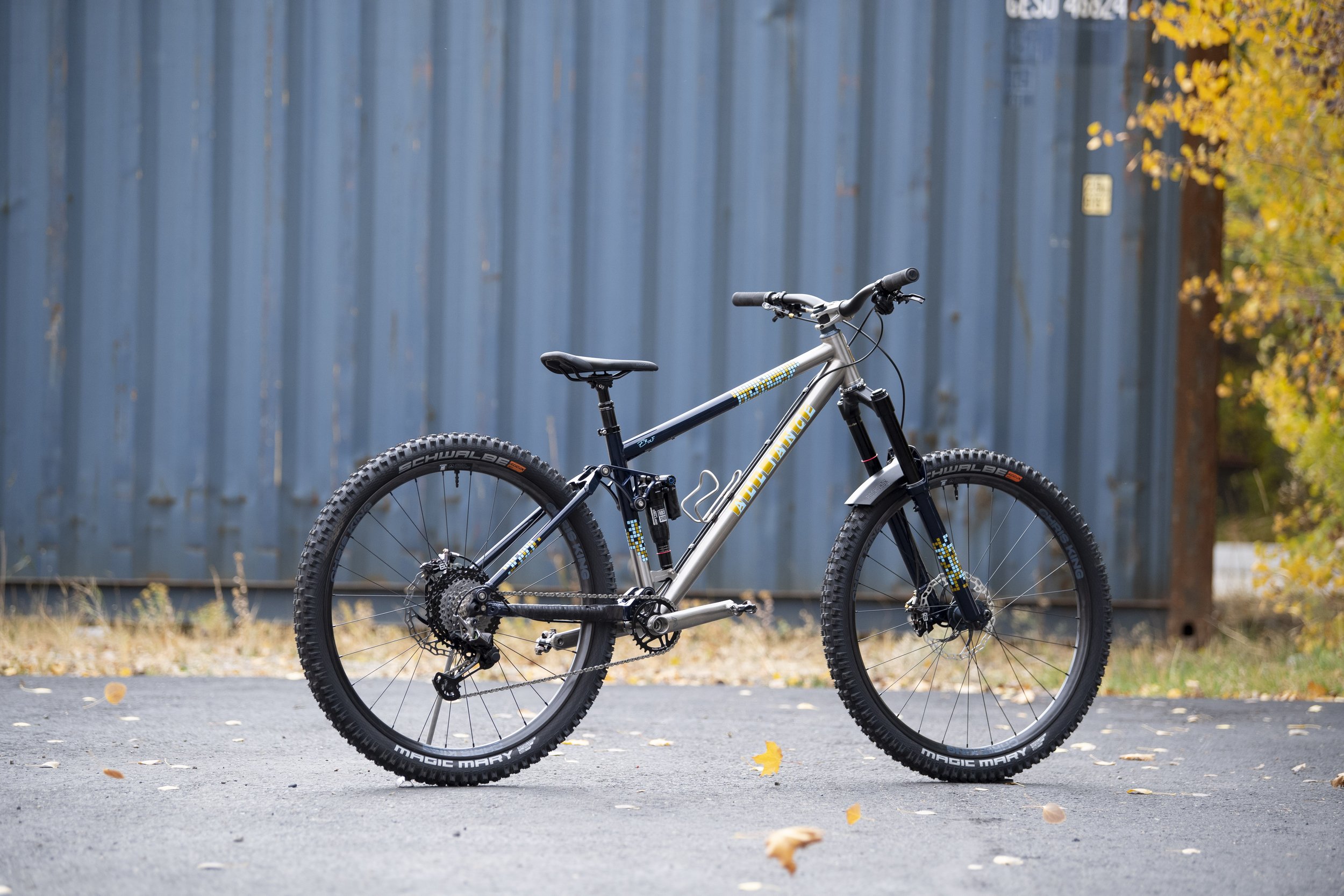
The current bike was displayed at NAHBS.  I’ve also posted a few times about the style of bike, as well as, some build photos which can be seen below.  I’ve included a bikeCAD file that displays all of the dimensions for fit and geometry.  The saddle height and bar drop can change, but they are listed for reference.  The stem is currently flipped -10 degrees with 20mm of spacers underneath.  The bike was design with a 23mm headtube extension so that no spacers could be used for most people, however I left the steer tube a little long just in case you need the additional handlebar height.  The stem could also be flipped in the positive rise direction.  Again, please feel free to email me with any questions.

Show Pony

img_4866 img_4942 img_4932 img_4906 img_4899 img_4896 img_4888 img_4881 img_4878 img_4876 img_4945

Practice Joints

This weekend I was at the shop hanging some new parts on the show bike.  Yes it’s back, no you can’t see pictures yet :) .  I figured since I didn’t have any tubes, I would just practice weld instead.  There’s always a good assortment of steel tubes to weld because 99% of seat tubes are trimmed to length.  For the last few months I’ve been hording  decent length titanium cutoffs like gold.  I hope to build a ti road bike for myself once the dust settles from the NAHBS rodeo.  I only had enough tubing for three joints, but I think there’s a few more around the shop. 

I was truly shocked at how different titanium behaves in all facets of construction.  It machines differently, cleans up differently, and welds differently than steel.  All things I’ve heard time and time again, but sometimes you’ve got to experience it. 

The other day, Carl was explaining why he liked to weld titanium because it’s not as hot.  I didn’t really have a frame of reference at the time, but I did know that steel can get pretty hot.  When welding a frame, you rest your hand on one of the tubes to steady the torch.  Ideally you want to make fairly long passes to avoid starts and stops, which cosmetically don’t look so hot.  At the same time, the torch must move at a rate of speed which allows the metal to cool before advancing too far out of the argon coverage zone.  When making a really long pass it’s more of a pain threshold test because your palm is heating up.  However on ti, you can bring a sack lunch and camp out because it doesn’t conduct as much heat.  I’ve only done a few titanium joints, but I’m already hooked.

Below is a  picture of the fusion pass.  This pass uses little to no filler rod.

img_0571

This is the dress pass.  Filler rod is used here to alleviate any undercut and ensure a strong joint.  In short, two passes are chosen because titanium doesn’t weaken from multiple heating/cooling cycles.

Why say it again, when you’ve got this explianaiton of double pass welding http://www.strongframes.com/blog/?p=3391 

  img_0580

Dirtroad Bikes

Warning: Extreme Bike Geekery Ahead

I have received a few questions about the style of bike I’m taking to NAHBS.  This type of bike is usually called a dirtroad bike, all-arounder, or a rain bike.  A lot of what defines this bike is builder dependent, however suffice to say, it’s much more than a cyclocross bike with fender mounts.

  • In general, the bottom bracket will be in line with a classic road stage race bike, around 70mm-80mm of drop.
  • This lowers the rider’s center of gravity which increases stability when riding smooth tires on gravel roads.
  •  The chainstays will be shorter than a cross bike, but longer than that of a road bike.  Mine are 420mm which is enough to clear fenders and tires, but still keep the wheelbase in check.
  •  To counterbalance the longer backend, I slacken the head tube angle to 72.5 degrees and increase the fork rake to 46mm.  These two things maintain the handling characteristic of a normal road bike, but keep the rider centered between the wheels for even weight distribution.
  • This provides a trail measurement of about 59mm with the appropriate tires, which is typical of a road bike.
  • The slacker head tube/increase in fork rake combined with the longer chainstays help soften the ride on rough roads.

The most common tire size I see ranges from 24c to 33c.  This type of bike is also fitted with fatter 650b wheels if the rider desires more comfort.  I could also see shorting the cockpit  or raising the handlebar for a more upright fit. 

Brake style is also rider dependent and will vary between caliper, cantilever, or disc.  In the past I’ve always used canti’s, but I prefer longer reach calipers for both their aesthetics and lack of maintenance.  Cantilevers tend to work themselves into a squealing frenzy unless you constantly readjust the pads for toe-in.  For the most part, I find this to be true when it’s wet or cold and under hard front braking.  Not so much if its dry and hot, but that’s not when I ride a bike with fenders on it.  I also find calipers to have a firmer lever feel, but if maximum tire clearance is needed, cantilevers work best. 

Disc brakes provide the best braking in poor weather.  I have used them as well, but the pads have to be set close to the rotor because road levers don’t pull very much cable.  Even with the Avid road specific BB7’s, the rotors have to be perfectly true or the pads will rub.  Disc brakes add a fair amount of weight and look out of place on a road bike to me.

In my experience, you will out brake the traction of a road tire before running out of stopping power, regardless of brake used.  This is not true if conditions are excessively wet or muddy, in which case, disc brakes are appropriate.  See below for photographic evidence of the fine dirt roads that surround Bozeman.

dscf0007 dscf0009 dscf0013

No news on the framebuilding front because I don’t have any tubes to build frames with right now.  All of my funds were sucked into the vortex called NAHBS, so I just practiced welding on some seat tube cutoffs and such.

img_0479 img_0481

Show Bike

 I’m just about done with the second dirt road bike except for braze-ons.  The second one turned out a little better, so I will be sending it to spectrum in the next few days.  Some quick stats include OX Platinum 31.8mm DT and 28.6mm TT, both with .7-.4-.7 wall thickness for the front triangle.  The back half has true temper 16mm-11mm tapered seatstays and Columbus teardrop shaped chainstays.  A Columbus 1.1mm head tube and True Temper externally butted seat tube complete the frame.

1 2

Chainstays and Seatstays ready to be mitered.

3 4 5

It’s essential that the seat tube is perfectly aligned perpendicularly with the bottom bracket or the rider will be biased towards one side of the bike.  The rider will then have to rock his/her hips to compensate for this.  If it’s perfect the bar will slide in without having to push the seatube up or down.   It’s stepped for different size seattubes.

6

Checking for fender/tire fit one last time before I weld the rear triangle on.  At this point, it’s only tacked and can be adjusted if needed (read: break the tacks, bend or dimple stays, retack, recheck).  I can simulate this in the fixture to a certain extent, but I like to have the real thing fit before I weld the frame.  

7 8 9

Going To NAHBS

The North American Handmade Bike Show is coming up at the end of February.  I had the opportunity to help out with Carl’s booth last year.  This year I will be attending NAHBS as an exhibiter.  I will be displaying a bike in the new builders section that was recently added. My page on the NAHBS website can be found at:

http://www.handmadebicycleshow.com/2009/12/alliance-bicycles/ 

Only one bike is allowed in the new builder section at the show.  It was really tough to narrow it down to only one frame because I like so many different styles.  I decided to build what I consider to be the quintessential Bozeman road bike.  Around here, the paved roads are straight and flat, as they surround large farm plots.  We jokingly call the most popular loops “around the block” or “the Bozeman track”.  If you want to make a ride longer you just make a bigger square.  However, we do have quality fireroads and footpaths as far as the eye can see.  The in-town singletrack and dirt roads don’t excite the mountain biker in me, or really require a mountain bike for that matter.  However, a bike with a pair of 28c tires allows me to ride all preseason long without going crazy. I just link all the good dirt sections with the pavement roads.  There are awesome mountain logging roads and singletrack trails with some good high-speed sweepers to keep it interesting.   It’s also about the only way to get some elevation gain.

The bike will be a built with a lighter tube set for me (about a 6 on the stiffness scale).  It’s based around long reach calipers to clear 28c tires with fenders, or 30c tires without.  I will be building two of the exact same bike and will take the better of the two.

The bike will also get the full treatment from spectrum powderworks, which I’m really happy about.  It has been hard not to paint any of my bikes because they look and feel unfinished.  My Dura-Ace 7800 grouppo, Ritchey/Bontrager cockpit, handlaced wheels mated to Challenge Paris-Roubaix tires, and a pair of Berthoud fenders comprise the tentative build.  The first bike is about half done.

img_0386 img_0387 img_0399

img_0396

Single Speed Cyclocross

I finished a new cyclocross bike this weekend.  I think that this style of bike works great for getting around from one place to another.  It’s just a basic cross bike set up as a single speed.  Throw on some fenders with a mixed bag of old parts, and you’re ready to ride. 

I had to recycle all the parts off of my first bike.  I really wish that I could keep riding that bike, because it works so well and it’s a lot of fun.  It’s hard not to become nostalgic over my first frame, but I need to keep building bikes.  My first bike had a nice patina going too!

1

Some build photos

3 2

I packed a walloping one degree of slope into that top tube.

5

The stats on this one are 572mm top tube, 600mm c-t seat tube, 425mm chainstay at the most forward position, and a 110mm stem.  Full OX platinum tubeset, except the chainstays.  The bike also has full provisions for derailleurs. 

6 7 8 9 10

The fork is built with a 400mm axle to crown height for a little more clearence when the tires have snow on them.

11 12

New Commuter

I completed the fork for my new bike earlier last week.  I used  28.6mm/20mm tapered True Temper fork blades.  This bike will have disc brakes, so I wanted a fork that wouldn’t chatter under hard braking, but also had a nice ride to it.  This fork sits in the middle of the three common sizes for unicrown blades.  

The fork blades have been mitered to width and are roughly mocked up for length.

Next, I miter the steer tube to match the radius of a fender.  It also looks better than a square piece of tube sticking out.


The fork has been fitted for length, width, and rake.  It’s ready to tack and weld.

Last week, Carl decided the alignment table needed a little bit of love.  I stripped it all the way down and polished off all of the surface rust and grim.   At this point, I’ve removed most everything and polished it twice with a 3M pad and some cleaner.

I gave it one more polishing and then waxed it to seal the new finish.


I went skiing at Big Sky on Saturday for my brothers birthday.  It was great conditions  for early season.  I snapped a few photos that look out into the Gallatin Crest area.


I was going to ski again on Sunday, but I stopped listening after the snow report stated -10 degrees at mid mountain.  So instead, I went into the shop and built the frame to go with my new fork.  It’s built with mostly OX Platinum, except the chainstays, which are 3/4 inch 4130.  The down tube is 34.9mm, top tube is 28.6mm, 28.6mm externally butted seat tube, and 16mm tapered seat stays round out the package. 


Front triangle mitered and tacked.

Checking the head tube for twist midway thru welding.

Chainstays tacked, just need to miter seatstays and then weld the back half.

Almost done, except for bridges, braze-ons, and a rear disc mount.

Interesting Article

A good friend of mine just sent me a short article from competitive cyclist.  It rang true to my feelings on becoming a framebuilder.  I’ve stated before, that if I couldn’t learn as an apprentice, I probably wouldn’t have gone down this path.  It’s not that I think you can’t become a framebuilder any other way, I just prefer to do it this way.  Hell, you can eventually learn to build frames by just plugging away in the garage after work.  However, this process is extremely slow and doesn’t produce respectable results for a long time. 

It takes a long time to become good at something, and I believe building frames is no different.  That’s why I don’t paint my frames, or sell them, or build for other people that aren’t direct family.  Pure and simple, my bikes aren’t ready; I’m not ready. 

I think every bike that I’ve built has been far above my experience level.  They are straight, the wheels aren’t crooked in the dropouts, the welds are uncontaminated and fully penetrated, but they still have flaws.  Some of the flaws are obvious some are little flaws that most wouldn’t notice until I point them out. But they’re still not ready in my mind.  Tone on tone colors, pastel panels, and liquid paint won’t change the fact that it’s only my sixth frame.

http://www.competitivecyclist.com/road-bikes/whats-new/rookie-vs.-apprentice.332.html

New Tools

I’m out of the shop this week, well at least Carl’s shop.  I’m in Hailey for Thanksgiving and my birthday.  My good friend Eric Coury is also in the process of becoming a framebuilder.  I stopped by his shop to check out some of his new tools.  He just received a new sputnik frame fixture that is nice!  He is currently working on a pair of pump track bikes for some friends of ours, which are also looking nice.  In his free time the shop guys mess around with vintage Ferrari restorations.

I also received a new tool for my birthday last Saturday.  My dog loves nothing more than to open presents.  I think it was just as much fun for him to rip open that Anvil BBG!